The git cherry-pick command allows you to apply one or more commits from any other branch in the repository to the HEAD of the current branch.
Cherry-picking is useful when you do not wish to apply all commits on a source branch to the current branch.
If you aim to merge all commits from a source branch into the current branch, you should instead use Merge or Rebase.
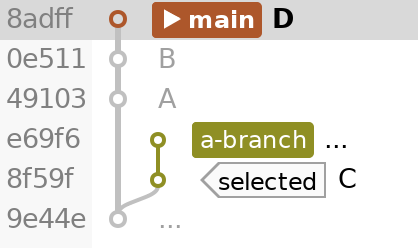
In the example below, we want to cherry-pick commit C from the branch a-branch into the HEAD of the current (target) main branch.
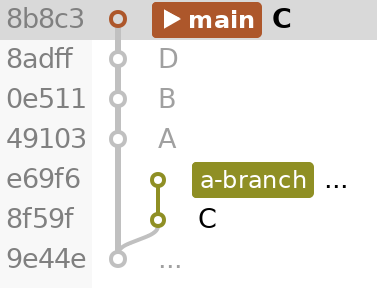
This will append a new commit C', equivalent to C, onto the main branch.
Beforemain points to D; C lies on a-branch.
Git commands
git cherry-pick selected
Aftermain has a new copy of C after D; a-branch retains the original C.
Recreate this repository
Run these commands in a fresh directory.
git init -b main
echo Example repository > README.md
git add README.md
git commit -m"..."
git switch -c a-branch
echo C > c.txt
git add c.txt
git commit -m"C"
git tag selected
echo More work on a-branch > continuation.txt
git add continuation.txt
git commit -m"..."
git switch main
echo A > a.txt
git add a.txt
git commit -m"A"echo B > b.txt
git add b.txt
git commit -m"B"echo D > d.txt
git add d.txt
git commit -m"D"
Note
Cherry-picking commits should be done carefully.
In the above example, after cherry-picking C, a future attempt to merge a-branch into main could result in merge-conflicts because C and C' may conflict.
If a conflict occurs during cherry-picking, the working tree will enter ‘Cherry-Picking’ status.
You’ll either need to resolve the conflict (e.g., using the SmartGit Conflict Resolver) and complete the cherry-pick or abort the cherry-pick attempt.